SCAGLIOLA FAQ’s
-
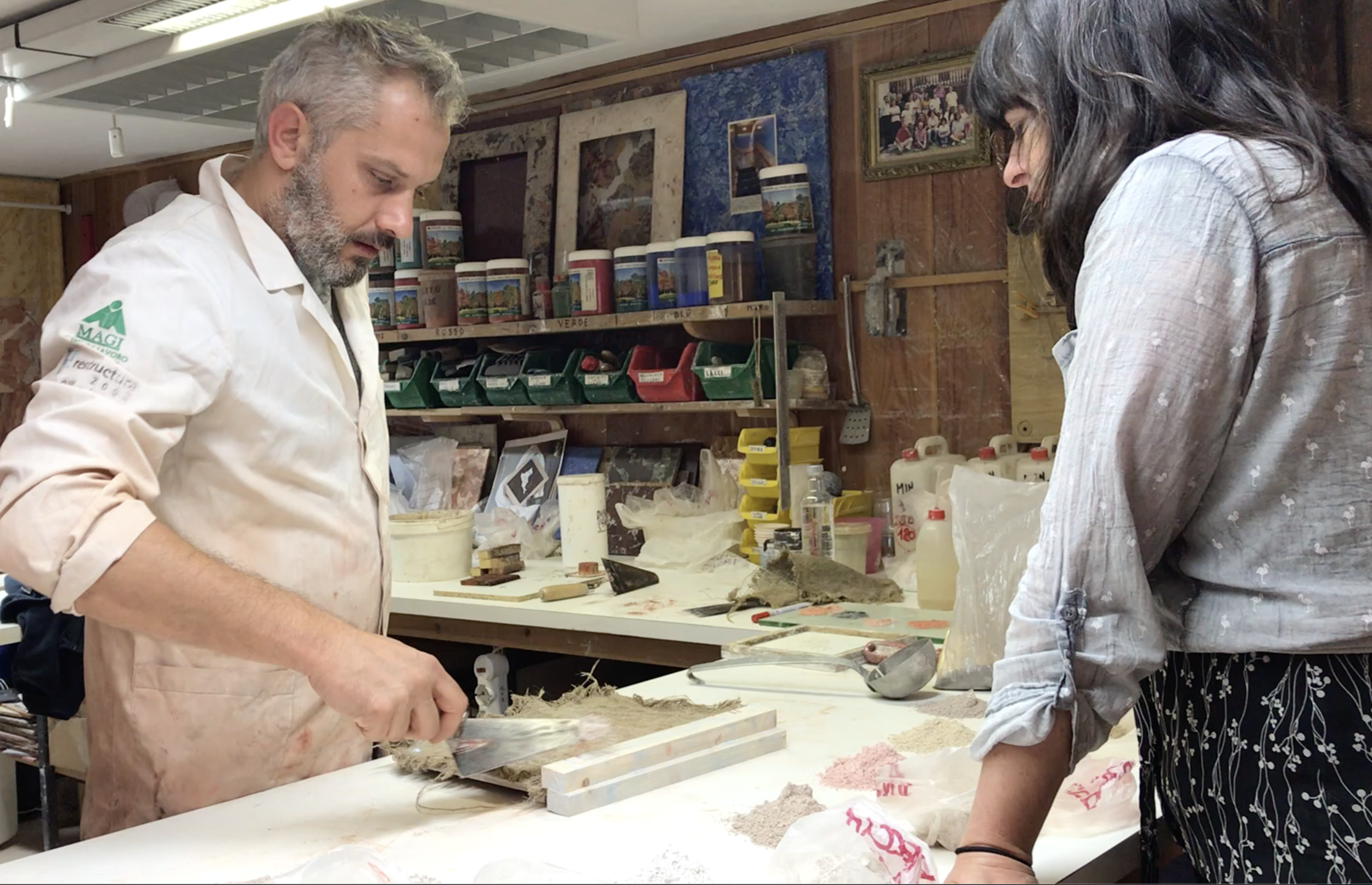
Scagliola is a technique for imitating marble and inlaid stone using plaster (traditionally gypsum), pigment, and animal glue. The mixture is applied, then ground and polished until it reads as stone. The name comes from scaglia, meaning chip or flake, a reference to the selenite (a crystalline gypsum) used in early recipes.
Scagliola begins with plaster, and I use Hydrocal as my base. Glue is added in a wide range of recipes to make the plaster cure more slowly than it typically would
-
Each color you see is a pigment mixed into the plaster in batches. If you scratch the scagliola surface, you will see the color runs deep into the core of the piece. The color is through and through. is a surface of sagliola there can be 30-40 color differences at play. Each subtle color change form light tp dark to changes of hue are all mixed individually and worked into the patterning.
-
To achieve the highest possible polish on scagliola, the work must be wet-sanded through a progression of grits: 220, 400, 600, 800, 1000, 1500, and 3000. The polish is created solely through this elaborate sanding process, with each stage building on the one before. Once the shine is created in this way, wax polish is the final step. this seals and protects the surface.
-
Scagliola is not suitable for exteriors and cannot withstand years of exposure to the elements. It is very strong, but not against nature.
-
Scagliola can be found across central and northern Italy, the region where many of its techniques were developed, and I see it as the home of scagliola. It is also found widely across Europe. Historically, it was used on the walls of royal palaces, churches, and government buildings. Scagliola inlay appears on large altar fronts across Italy. It was also often used to make large columns, and I have seen scagliola columns in Cuba, Portugal, throughout Italy, and across the United States, in Carnegie libraries and statehouses
-
Yes, by a small community of artisans, conservators, and artists, in Italy and elsewhere, including contemporary studio work that treats it as a fine-art medium rather than only a decorative one. Scagliola is still new to the fine arts realm and especially rare in the United States. I have worked with the medium for ten years and have found a growing interest in, and respect for, what scagliola is capable of. -
Most histories place the development of decorative scagliola in northern Italy in the 1600s, with Carpi in Emilia associated with the early refinement of inlay work (often credited to Guido Fassi). Tuscany became a major center, and artisans from the Intelvi Valley carried the technique across Europe. I am most influenced by the school of scagliola that came out of Rima, Italy, whose artisans produced countless scagliola architectural elements across Europe for many generations